
Knee and Ankle Pain in Penrith — When a Podiatrist Can Help
TL;DR
Knee and ankle pain often has a biomechanical root — the way your foot contacts the ground and the way load travels up through your ankle and knee. A podiatrist can assess the full lower limb picture and address the contributing factors, including custom orthotics, shockwave therapy, and injection therapy. Penrith Podiatry sees referral-grade cases that other clinics refer on.
Why Knee and Ankle Pain Often Starts Further Down
The foot, ankle, knee, and hip don't work in isolation. They form a kinetic chain — and when something goes wrong at one point, the effects travel. Excessive pronation (rolling inward) at the foot changes the angle of the tibia, which changes the loading through the knee. Restricted ankle range of motion compensates through the knee and hip. Problems that look like a knee issue often have their origin further down.
This is why a biomechanical assessment of the foot and lower limb is relevant to knee and ankle pain — not just to conditions that present at the foot. Identifying and addressing the mechanical contributors doesn't replace orthopaedic care for structural problems, but it often addresses the driving factor that keeps symptoms returning.
Common Conditions a Podiatrist Sees at Penrith Podiatry
Patellofemoral Pain Syndrome (Runner's Knee)
Pain around or behind the kneecap that worsens with running, stairs, or prolonged sitting is often classified as patellofemoral pain syndrome. Foot and lower limb biomechanics frequently contribute — particularly excessive pronation that increases the valgus load on the knee. Orthotic intervention combined with a targeted rehabilitation program is the most common management pathway.
Achilles Tendinopathy
Achilles tendinopathy produces pain and stiffness along the Achilles tendon, typically worst in the morning or after a period of rest followed by loading. It's a load-management problem rather than an acute injury, and addressing gait mechanics alongside load reduction is the foundation of treatment. Shockwave therapy is an evidence-based adjunct for chronic cases that haven't settled with conservative care alone.
Ankle Sprains and Instability
A single significant ankle sprain, or repeated minor sprains, can leave the ankle mechanically unstable. Without proper rehabilitation, proprioception and ligament function remain compromised. A podiatric assessment identifies the residual deficit and guides a rehabilitation approach that goes beyond rest and waiting.
Shin Splints (Medial Tibial Stress Syndrome)
Shin pain that builds through activity and settles with rest is often medial tibial stress syndrome. The condition is closely associated with training load and foot mechanics — particularly in runners who have changed their surface, footwear, or training volume. Addressing the biomechanical component alongside load management is usually required to settle it properly.
Plantar Fasciitis with Referred Pain
Plantar fasciitis presents primarily as heel pain, but the altered gait patterns that develop in response to heel pain can create secondary loading problems at the ankle and knee. Treating the heel pain and addressing any biomechanical compensation prevents the downstream effects from becoming the ongoing problem.
What a Biomechanical Assessment Involves
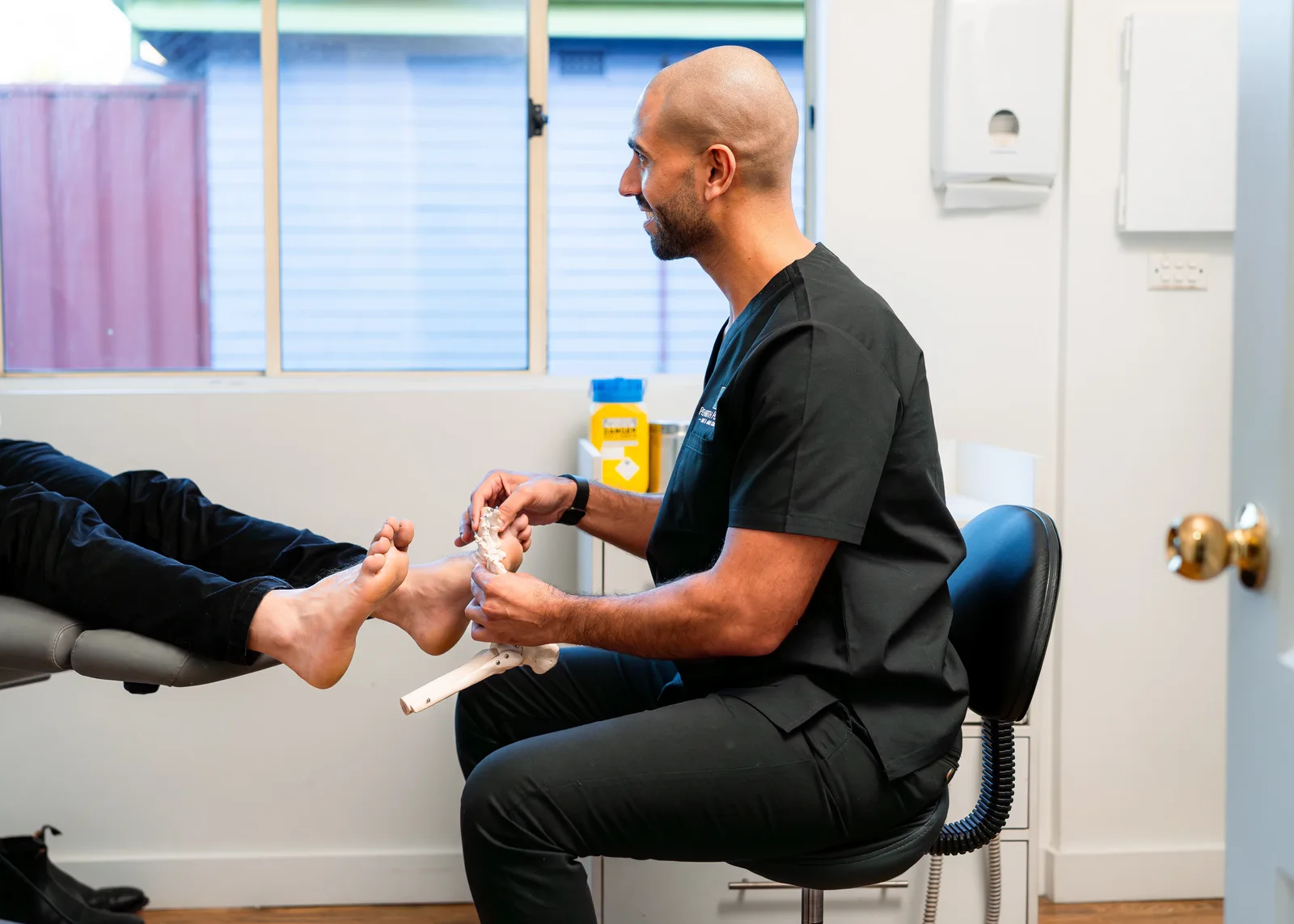
A biomechanical assessment at Penrith Podiatry goes beyond a brief observation of how you walk. It includes a detailed clinical history, assessment of joint range of motion at the foot and ankle, muscle strength and flexibility testing, gait analysis — both walking and, where relevant, running — and an assessment of footwear.
The goal is to identify what's actually driving the symptoms, not just where they're presenting. A patient presenting with knee pain may leave with an orthotic prescription aimed at the foot and a different understanding of why the knee wasn't settling on its own.
Treatment Options at Penrith Podiatry
Custom orthotics are prescribed to your specific biomechanics from a detailed assessment — not off-the-shelf insoles applied broadly. They work by changing the forces that travel through the foot and up the lower limb during activity.
Shockwave therapy is available in-clinic for chronic tendon and soft-tissue conditions that haven't settled with first-line care. It stimulates the body's healing response and is particularly useful for Achilles tendinopathy and plantar fasciitis.
Injection therapy — including corticosteroid and ultrasound-guided options — is delivered in-house where clinically appropriate, without requiring a separate specialist referral.
For cases that genuinely need surgical input, the clinic has a Surgical Podiatrist on the team for complex and referral-grade presentations. This means patients don't need to be sent elsewhere when a condition escalates.
When to See a Podiatrist vs a Physiotherapist or GP
The right starting point depends on what's driving the pain. A podiatrist is a good first call when:
- The pain has a clear foot or ankle component, or is related to how you walk or run
- You've had conservative treatment elsewhere and the problem keeps returning
- You need orthotics, footwear advice, or a lower-limb biomechanical assessment
- The condition involves a tendon, fascia, or nail/skin structure of the foot or ankle
A physiotherapist is often the better first call for muscle-dominant problems, post-surgical rehabilitation, or conditions primarily affecting the hip, spine, or shoulder. A GP is appropriate when you need imaging, blood tests, or a broader medical assessment. Many Penrith Podiatry patients come through GP and sports physician referrals — the clinic sits comfortably within a wider referral network.
Knee or ankle pain that hasn't settled? A biomechanical assessment is the starting point. Same-day and next-day priority bookings available where capacity allows.
Call 1300 470 220 — 1/135-137 High Street, Penrith NSW 2750
Frequently Asked Questions
Can a podiatrist help with knee pain?
Yes. When knee pain has a biomechanical contributor — such as excessive foot pronation, restricted ankle range of motion, or altered gait — a podiatric assessment and intervention can address the driving factor. Podiatrists don't treat all knee conditions, but for biomechanically driven presentations, they are often the most relevant first call.
What is a biomechanical assessment?
A biomechanical assessment is a clinical evaluation of the way your foot, ankle, and lower limb function during walking or running. It includes joint range of motion testing, muscle assessment, gait analysis, and footwear review. The goal is to identify the mechanical factors contributing to your symptoms.
Do I need a referral to see a podiatrist at Penrith Podiatry?
No referral is needed. You can book directly. The clinic does receive referrals from GPs, sports physicians, and orthopaedic surgeons, but self-referral is entirely appropriate for most presentations.
What treatments are available in-clinic for ankle tendon problems?
Penrith Podiatry offers shockwave therapy and injection therapy in-clinic for tendon and soft-tissue conditions. Custom orthotics and exercise rehabilitation guidance are also provided. For cases that require surgical assessment, there is a Surgical Podiatrist on the team.
How many appointments will I need?
This depends on your condition and its severity. Some patients benefit from a single assessment and orthotic prescription. Others with chronic tendon problems may require a course of shockwave therapy or injection therapy. Your podiatrist will outline an expected management pathway at your first appointment.
Explore related conditions & services
Knee & Ankle Pain
Knee and ankle pain often starts at the feet - we assess the whole chain, not just where it hurts.
Learn moreAchilles Tendon Pain
Stiff, aching pain in the Achilles tendon - a loading problem that responds to structured rehab.
Learn moreBiomechanical Assessment
A detailed evaluation of how your feet, legs and lower limb align and move - standing and walking - to find the mechanical cause of pain.
Learn moreShockwave Therapy
Non-invasive shockwave (ESWT) for stubborn heel pain, plantar fasciitis and chronic tendinopathy.
Learn more
Have a foot or ankle concern?
Reading up is a good start - but nothing beats a proper assessment. Book in and we'll diagnose the cause and map out a plan. Serving Penrith and the wider Western Sydney region.