
That Dark Toenail Is Telling You Something
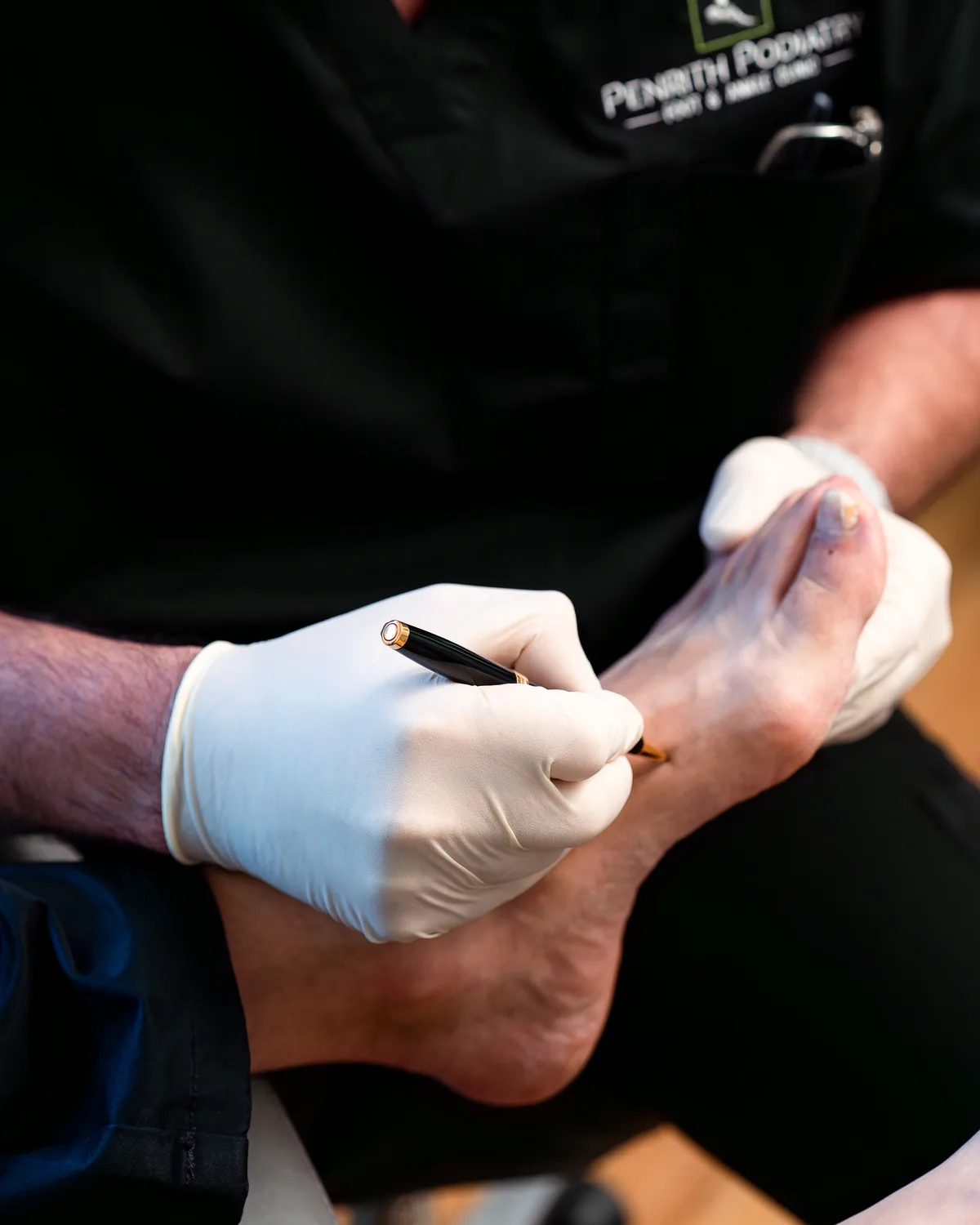
A bruised toenail can range from a minor inconvenience to a throbbing, nail-threatening injury. More rarely, it can be something else entirely. Here's how to tell the difference — and what to actually do about it.
Quick summary
- A bruised toenail is a subungual haematoma: blood pooling beneath the nail plate after trauma or repetitive pressure.
- Colour ranges from red and purple through to dark blue and black depending on age and severity.
- Healing takes 6 to 12 months because the discolouration grows out with the nail, not fades in place.
- A badly bruised toenail may cause the nail to separate and fall off. A new nail will grow back.
- Not every dark toenail is a bruise. Fungal infection and, rarely, melanoma can look similar.
- Severe bruising with significant pain requires podiatry assessment to drain the haematoma safely.
What Is a Bruised Toenail (Subungual Haematoma)?
The clinical term is subungual haematoma. The everyday term is a bruised toenail. Both describe the same thing: blood that has pooled between the nail plate and the nail bed after the small blood vessels beneath the nail are damaged by trauma.
The blood becomes trapped because there is nowhere for it to drain. As it collects, pressure builds under the nail, which is what causes the characteristic throbbing pain. Over time, the blood oxidises and darkens, producing the deep red, purple, or black discolouration most people associate with a bruised toenail.
The toenail itself is not damaged in the way skin is. It doesn't bruise the way a muscle does. What you are seeing is blood pooled in the sealed space beneath the nail, with the nail plate itself acting as a rigid cap that prevents natural drainage.
Key fact: Unlike a bruise on skin, a bruised toenail does not fade over days or weeks. The discolouration is locked beneath the nail plate and only disappears once the nail grows forward enough to carry it off the end of the toe. Depending on the size of the haematoma, this can take anywhere from 3 to 12 months.
What Does It Look Like? Reading the Colours
One of the questions people ask most is whether the colour of their bruised toenail tells them anything. It does. The shade you see under the nail reflects the age of the blood and, to a degree, the severity of the bleed.
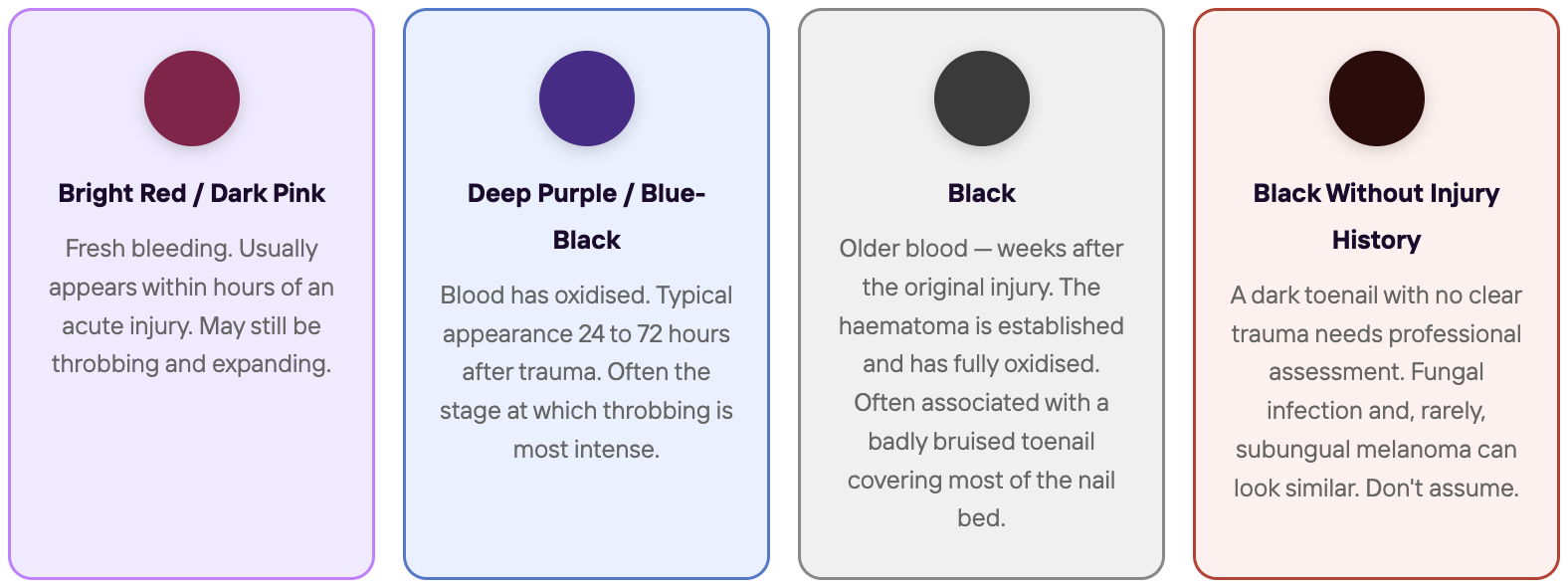
Bruising underneath the toenail most commonly affects the big toenail, simply because it is the largest and most exposed to impact and shoe pressure. However, bruising in toenails on the second and third toes is also frequently seen, particularly in runners and people who wear narrow or short footwear.
What Causes Bruising Under the Toenail?
The root cause is always some form of force applied to the toe. The circumstances in which that force occurs vary considerably.
- Acute Trauma: Dropping a heavy object onto the foot. Stubbing a toe hard against furniture, a doorframe, or the ground. Being stepped on. These are the most obvious causes and tend to produce immediate, intense pain followed by visible bleeding beneath the nail within minutes to hours. The haematoma is usually large when caused by acute trauma and may rapidly turn dark purple or black.
- Repetitive Pressure and Footwear: This is actually the more common cause, particularly among people who are physically active. When shoes are too short, too narrow, or lack adequate toe box volume, the toes are repeatedly pushed forward with every step, pressing the nail against the shoe. Over thousands of steps, this cumulative micro-trauma causes bruising under the toenail that builds gradually, often without any single obvious incident. Shoes with a heel that pitches the foot forward (dress shoes, court shoes, high heels) are especially problematic because they increase the load on the toes during every walking cycle. Ill-f
- Nail Length: A toenail that is too long has more surface area to catch on the shoe during activity. Each catch drives the nail back into the nail bed, creating micro-bleeding that accumulates over time. Keeping toenails trimmed to just beyond the tip of the toe is one of the most effective prevention strategies — but trimming them too short creates a different set of problems, including ingrown toenails.
- Activity Type and Terrain: Downhill running is particularly hard on toenails because the foot slides forward in the shoe with each downhill stride, driving the toes into the front of the shoe. Stop-start sports where the foot decelerates rapidly within the shoe — tennis, basketball, netball, squash — produce similar effects. Hiking on steep descents is another common setting for bruising toenails, particularly on the big toe.
Runner's Toe and Sport-Related Toenail Bruising
"Runner's toe" is the informal name given to a bruised toenail from running, particularly from distance running, trail running, or any running that involves sustained downhill grades. It's one of the most common complaints among recreational runners and is almost always preventable.
- Running and Trail Running: Downhill stride mechanics drive the foot forward repeatedly. The second toe is often the worst affected in runners because it frequently extends further than the big toe.
- Hiking and Trekking: Long descents on uneven terrain create sustained toe-to-shoe contact. Poor lacing technique that allows the foot to slide is a major contributing factor.
- Court Sports: Rapid deceleration and direction changes in tennis, squash, netball, and basketball repeatedly push the foot into the front of the shoe. Bruising toenails is common in players who compete frequently.
- Football and Field Sports: Kicking a ball — especially with the toe-box — can cause acute bruising on the toenail bed of the big toe. Studs that don't flex adequately also add rigid pressure during running.
- Dance (especially ballet): Pointe work concentrates enormous pressure on the tips of the toes and the nail beds. Bruised toenails are considered an occupational reality in classical ballet.
- Rock Climbing: Tight, aggressive climbing shoes press the toes into a cramped position. Sustained pressure on small footholds concentrates force directly under the nail bed, causing bruising over time.
Running with a bruised toenail is possible in mild cases with adequate cushioning and the right shoe fit, but should be assessed by a podiatrist first if the bruise covers more than a quarter of the nail, is throbbing, or has caused the nail to feel loose.
Bruised Toenail or Melanoma? How to Tell the Difference
This is one of the questions podiatrists are asked most when a dark toenail appears without a clear injury history. It is a legitimate concern, not an overreaction. Subungual melanoma is a form of skin cancer that develops beneath the nail and can look, at a glance, like a bruised toenail — particularly in its early stages.
This does not mean every dark toenail is suspicious. The vast majority of discoloured nails are caused by trauma. But the distinction matters, and the comparison below gives you a useful framework.
- Cause: Bruised toenail: Clear trauma or repetitive pressure history. Subungual melanoma: No injury history in most cases.
- Appearance: Bruised toenail: Diffuse blotch of dark red, purple or black beneath the nail. Subungual melanoma: Brown or black vertical streak (band) running from nail base to tip.
- Movement: Bruised toenail: Moves forward as the nail grows (grows out over months). Subungual melanoma: Does not move with nail growth; stays fixed at the base.
- Skin involvement: Bruised toenail: Confined under the nail plate only. Subungual melanoma: May extend onto the skin around the nail (Hutchinson's sign).
- Pain: Bruised toenail: Often present and corresponds to the injury event. Subungual melanoma: Often painless, especially early on.
- Edges: Bruised toenail: Irregular, smudged, colour may vary within the blotch. Subungual melanoma: Streak with relatively defined edges; width may vary.
- Who to see: Bruised toenail: Podiatrist for assessment and treatment if significant. Subungual melanoma: Podiatrist or dermatologist urgently for biopsy.
The rule — when in doubt, get it checked: If you have a dark toenail and you cannot clearly link it to an injury or sporting activity, see a podiatrist or GP. Subungual melanoma is rare, but it is far more treatable when caught early. A podiatrist can assess the nail in clinical context and refer appropriately if anything is suspicious. Never self-diagnose a dark toenail you cannot explain.
Bruised Toenail or Fungus? Another Common Confusion
Fungal nail infection (onychomycosis) is far more common than melanoma and, in some presentations, can look similar to an old or mild bruised toenail. Both can produce a dark, discoloured, thickened nail. The key differences:
- A bruised toenail typically produces a distinct area of purple, blue-black, or black discolouration with relatively clear borders. The nail texture may remain normal initially, and the nail often grows forward carrying the discolouration with it.
- A fungal nail tends to start at the tip or sides of the nail and progress inward. The nail often thickens, becomes brittle and crumbly, and may develop a yellow or brown, powdery discolouration rather than the dark pooled blood colour of a haematoma. There is typically no trauma history.
- A nail can also have both conditions simultaneously: trauma can create a nail that lifts slightly, creating an entry point for fungal infection to establish underneath.
Bruise on toenail or fungus: if you have any doubt, a podiatrist can usually make a clinical diagnosis from physical examination. Where necessary, a nail clipping can be sent for laboratory analysis to confirm whether fungal organisms are present.
The Healing Timeline: How Long Does It Take?
This is where most people are caught off guard. A bruised toenail does not heal in the same way a bruised muscle heals. The blood cannot be reabsorbed beneath the nail plate, so the discolouration does not gradually fade over days or weeks. Instead, it stays locked in place until the nail grows forward enough to carry it off the end of the toe.
- Days 1 to 3 — Acute phase: Pain and throbbing are at their worst as blood pools and pressure builds under the nail. The discolouration darkens rapidly from red to deep purple or black. If the haematoma is large, the nail may feel loose.
- Week 1 to 4 — Pressure settles: Throbbing reduces as the pooled blood stabilises. The nail remains darkly discoloured. The nail may start to separate from the nail bed if the bruise covers a significant area. There should be no pain at this point unless infection is present.
- Month 1 to 6 — The nail grows forward: The discoloured portion of nail moves forward with normal nail growth. A new, healthy nail is growing from the base. If the nail separated, it may fall off during this period — a new nail is underneath. Regrowth may initially appear thickened or ridged.
- Month 6 to 12 — Full resolution: The bruised portion has grown off the end of the toe. A new nail has grown through to replace it. The bruised toenail healing process is complete. For a badly bruised toenail covering the entire nail bed, expect closer to 12 months.
Bruised toenail no pain: is that normal?
Yes. Once the acute pressure phase settles (usually within the first week), a bruised toenail should not be significantly painful. A bruised toenail with no pain and no signs of nail separation or infection can generally be left to resolve on its own. Pain that returns or worsens after the first week, or discharge appearing around the nail, warrants assessment.
What to Do at Home (and What to Avoid)
For a mild to moderate bruised toenail, conservative home management is appropriate. For a large, severely painful, or rapidly expanding haematoma, see a podiatrist promptly.
Safe at home
- Ice immediately after injury: Apply an ice pack wrapped in a cloth for 15 to 20 minutes as soon as possible after the trauma. This can reduce the volume of bleeding and limit the size of the haematoma.
- Elevation: Elevate the foot above heart level in the first few hours to reduce blood pressure to the area and limit pooling.
- Footwear modification: Switch immediately to open footwear or shoes with a deep, wide toe box that do not press on the bruised nail. Continued pressure on an active haematoma worsens pain and slows healing.
- Pain relief: Over-the-counter analgesia (paracetamol or ibuprofen if appropriate for you) can manage the throbbing pain in the acute phase.
- Protection: A gel toe protector or silicone toe cap from the pharmacy cushions the bruised toenail and prevents further trauma during activity.
- Keep the area clean: If the nail is loose or lifting, keep the area clean and dry to prevent bacterial entry. Do not pull a loose nail off.
What not to do
- Do not drain it yourself: Online advice recommends heating a needle and drilling through the nail to release pressure. While this is a clinical procedure a podiatrist can perform safely, attempting it at home risks serious infection and permanent nail damage. Never attempt this yourself.
- Do not pull off a loose nail: If the nail has separated, resist the urge to remove it. The nail is still protecting the raw nail bed underneath. Premature removal exposes the bed to infection and can be extremely painful. Let it separate naturally or have it managed by a podiatrist.
- Do not ignore spreading redness or warmth: These are signs of infection. A bruised toenail that becomes infected requires prompt medical treatment, potentially including antibiotics.
- Do not ignore a dark toenail with no clear cause: If you cannot explain your bruised toenail with a specific injury or activity, get it assessed rather than waiting for it to "grow out."
When and How a Podiatrist Treats a Bruised Toenail
Most mild bruised toenails resolve without professional intervention. But there are clear situations where a podiatrist can make a material difference — either by relieving pain immediately, preventing complications, or ruling out a more serious diagnosis.
- Trephination (Nail Decompression): When a haematoma is large, freshly formed, and causing significant throbbing pain, a podiatrist can perform a procedure called trephination — creating a small, precise opening through the nail plate to allow the trapped blood to drain. This is done under sterile conditions using a fine instrument and provides rapid, often dramatic, relief of pressure and pain. The nail is not removed. The small opening closes over as the nail grows. Done correctly, trephination is one of the most immediately effective pain-relief procedures in podiatry — and far safer than any home alternative. Trephination is
- Nail Removal (Where Needed): In cases where the nail has significantly separated from the nail bed, is causing ongoing pain, or poses a risk of ingrowth as it grows back, a podiatrist may recommend partial or full nail removal under local anaesthetic. This is a straightforward in-clinic procedure and allows the nail bed to be examined, cleaned, and properly dressed. A new nail will grow back over the following months.
- Infection Treatment: If infection has developed around a bruised toenail — redness spreading from the nail, warmth, discharge, or increasing pain after the first week — your podiatrist will assess the severity and coordinate antibiotic treatment with your GP if required, alongside wound care and nail management.
- Footwear and Biomechanical Assessment: For runners, athletes, and anyone with recurrent bruising in toenails from activity, a podiatrist will assess not just the nail itself but the mechanical factors driving the problem. This includes gait analysis, footwear review, nail length guidance, and where appropriate, custom orthotic therapy to modify the load distribution through the forefoot during activity.
Bulk billed at Penrith Podiatry Clinic: If you hold a Chronic Disease Management (CDM) or Enhanced Primary Care (EPC) care plan from your GP, all podiatry visits at Penrith Podiatry Foot and Ankle Clinic are bulk billed. Call us on 1300 470 220 to check your eligibility before booking.
Frequently Asked Questions
How long does a bruised toenail take to heal?
The discolouration from a bruised toenail grows out with the nail rather than fading in place. Toenails grow approximately 1.5 mm per month, so a haematoma covering half the nail will take around 4 to 5 months to grow off the end. A badly bruised toenail covering the full nail bed can take up to 12 months to fully resolve. The acute pain typically settles within 1 to 2 weeks.
Will my bruised toenail fall off?
It depends on how much of the nail bed was affected. A small bruise underneath the toenail covering a minor area is unlikely to cause the nail to separate. A large haematoma that covers most of the nail bed will usually cause the nail to detach from the nail bed and eventually fall off as the new nail grows through from underneath. This can take several months. In the meantime, the old nail continues to protect the sensitive nail bed, so it is worth leaving it in place until it separates naturally.
How do I heal a bruised toenail quickly?
The fastest path to pain relief is professional trephination (drainage) within the first 24 to 48 hours of a significant injury, performed by a podiatrist. For mild cases, ice immediately after injury, elevation, and appropriate footwear reduce swelling and limit the volume of the haematoma. Beyond that, the bruised toenail healing process cannot be meaningfully accelerated — the nail simply needs to grow out, which takes months. What you can control is preventing further trauma to the nail while it heals.
I have bruising on my toenail from walking. Is that normal?
Bruising toenails from everyday walking usually points to a footwear fit problem rather than anything wrong with your foot. Shoes that are too short, too narrow, or that allow the foot to slide forward push the toes into the front of the shoe with every step. Over time, this repetitive micro-trauma causes bruising underneath the toenail. A podiatrist can assess your footwear and gait to identify what is causing the bruising and how to prevent it recurring.
Is a bruised toenail the same as a subungual haematoma?
Yes. Subungual haematoma is the medical term for a bruised toenail. "Subungual" means beneath the nail and "haematoma" means a localised collection of blood. It is the same condition described in clinical and everyday language. You will also sometimes see it referred to as runner's toe (when caused by running), black toenail, or toenail bruise.
Can I still run with a bruised toenail?
In mild cases where the bruise is small and pain is minimal, running is often possible with appropriate footwear modifications, good lacing technique, and a gel toe protector. In more severe cases where the nail is loose, the haematoma covers most of the nail bed, or pain is significant, running should be paused until the acute phase has settled and a podiatrist has assessed the nail. Continuing to run on a badly bruised toenail can cause the nail to separate prematurely, increase infection risk, and extend your overall recovery time.
How do I prevent bruised toenails from running?
The most effective prevention measures are: wearing running shoes that are half a size larger than your usual size to accommodate foot swelling during activity; ensuring there is a thumb's width of space between your longest toe and the end of the shoe; lacing shoes firmly through the ankle collar to prevent the foot sliding forward during downhill sections; keeping toenails trimmed to just beyond the tip of the toe; and wearing moisture-wicking socks that reduce friction between the toe and shoe. If you are regularly bruising toenails despite correct footwear, a podiatry assessment of your gait and foot mechanics is recommended.
Explore related conditions & services
Ingrown Toenails
A nail edge growing into the skin - relieved same-day, and permanently fixable for recurrent cases.
Learn moreFungal Nail Infections
Discoloured, thickened or crumbling nails - diagnosed and treated with laser, oral and topical options.
Learn moreFoot & Ankle Assessment
Comprehensive biomechanical and clinical evaluation to pinpoint the root cause of foot, ankle and lower-limb pain.
Learn moreSports Injury Assessment
Targeted assessment and return-to-sport planning for runners, athletes and active adults.
Learn more
Have a foot or ankle concern?
Reading up is a good start - but nothing beats a proper assessment. Book in and we'll diagnose the cause and map out a plan. Serving Penrith and the wider Western Sydney region.